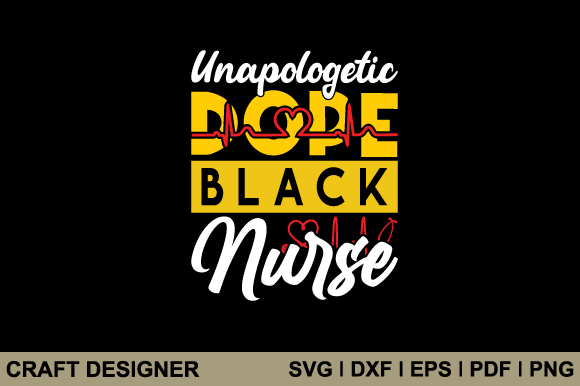
Unapologetic Dope Black Nurse SVG File
As a designer who’s stitched hundreds of custom pieces—from boutique aprons to hospital-themed baby blankets—I opened the Unapologetic Dope Black Nurse SVG File expecting boldness. What I found wasn’t just attitude—it was intention. This isn’t a generic “nurse appreciation” clipart knockoff. It’s a clean, centered, confident emblem: strong silhouette, stylized crown or headband motif, crisp lettering that reads clearly at 3–4 inches, and a visual rhythm that balances presence with wearability.
I tested it first on a heavyweight cotton tote bag—exactly the kind I stock in my small shop for nurse appreciation week. The design scaled beautifully from 3.2" to 4.5", holding detail without overcrowding the fabric. No pixelation in the PNG preview, no jagged edges in the SVG path—this is a well-constructed vector file, not a traced raster mess. That matters when you’re prepping for machine embroidery: clean vectors translate to smoother satin stitch outlines and more predictable fill stitch behavior.
The mood? Unmistakably proud, grounded, and warm—not performative, not overly decorative. It lands somewhere between professional recognition and personal affirmation. That makes it unusually versatile: ideal for embroidered patches sewn onto lab coats, but also subtle enough for a soft-knit baby onesie or a linen tea towel in a healthcare worker’s kitchen. I’ve seen too many “nurse” designs veer into cutesy or clinical; this one avoids both traps.
In real embroidery use, the Unapologetic Dope Black Nurse SVG File shines on stable, medium-weight fabrics: canvas totes, cotton sweatshirts, twill caps, and structured aprons. On a fleece-lined hoodie, I paired it with a lightweight cutaway stabilizer and a 60/8 sharp needle—no puckering, no thread breaks. The letterforms stayed legible even at 3.75", and the central icon held its shape through dense fill stitch without bleeding into adjacent areas.
Where it needs thoughtful handling: stretchy knits (like jersey tees), ultra-thin fabrics (baby muslin, voile), and curved surfaces like front panels of baseball caps. On those, I’d recommend simplifying the outer outline or reducing stitch density manually—especially if your embroidery software doesn’t auto-optimize for cap hoops. Also, avoid placing it near seams or darts where fabric distortion can pull stitches out of alignment.
Dark fabric? Yes—but test contrast first. I ran it in white thread on navy cotton duck and loved the impact. For black-on-black, skip it unless you’re adding a subtle puff or foil accent. And while the included PNG works fine for printable mockups or digital previews, remember: that PNG is *not* your embroidery file. Always open the SVG or EPS in your digitizing software to verify paths, node count, and layer structure before sending to your machine.
For Etsy sellers and craft business owners, this design supports authenticity—not just aesthetics. Customers notice when a product feels personally resonant versus mass-produced. A nurse gifting herself this embroidered pillow cover or wearing this patch on her scrubs bag isn’t buying decoration; she’s claiming space. That emotional resonance lifts perceived value, encourages repeat buyers, and fuels word-of-mouth in professional communities.
It also fits seamlessly into broader branding. Pair it with minimalist typography on a matching greeting card (using the PDF version), or combine it with coordinating icons in a holiday embroidery kit (think: “Nurse Appreciation Box” with mug, towel, and patch). As a digital embroidery file, it’s adaptable—not locked into one look. You can recolor it, resize it proportionally, or isolate elements for applique designs without losing integrity.
A few practical notes from the stitching floor:
- Always test on scrap fabric first—especially if using textured weaves like terry cloth or waffle weave towels.
- Check thread color contrast before hooping. Some shades of charcoal or navy read as black until you stitch them—and then they disappear on dark backgrounds.
- Review stitch density in your digitizing software. If the original file came pre-digitized (unclear from the description), inspect fill stitch spacing. Overly dense areas trap moisture and stiffen fabric—critical for baby embroidery or wearable items.
- Confirm hoop size compatibility. At full scale (4.5"), it fits comfortably in a 5x7 hoop—but double-check the actual dimensions in your software before finalizing.
- Inspect small details like inner curves or serif ends. If they’re under 0.04", they may vanish in satin stitch or require manual adjustment.
- Test in black-and-white mockups to assess readability—many buyers browse Etsy on mobile screens with reduced brightness.
- Compare light vs. dark fabric backgrounds in your design workflow. A design that pops on ivory may vanish on heather gray.
- Use appropriate stabilizer: cutaway for knits, tear-away for stable wovens, and fusible + tear-away for lightweight linens.
- Verify licensing terms before selling finished products or reselling the digital embroidery file. The listing says it’s “specially made”—but commercial use rights must be confirmed directly with the creator.
This isn’t just another graphics download. The Unapologetic Dope Black Nurse SVG File carries weight—visually, emotionally, and practically. It works because it respects both the craft and the wearer. Whether you’re embroidering a single personalized gift or stocking 50 tote bags for a hospital fundraiser, it delivers clarity, confidence, and quiet professionalism. In a crowded market of craft business assets, that kind of consistency is rare—and valuable.
If you’re an embroidery designer building a library of meaningful, production-ready files—or a small shop owner curating products that honor real people, not stereotypes—this belongs in your folder. Just remember: great design starts before the needle drops. Extract that ZIP, open the SVG, and stitch with intention.